Quillwave: Sparse-Sensor Reconstruction of Synthetic Ripple Fields
Research in preparation
Abstract
Quillwave reconstructs a full 256x256 ripple field from 64 point sensors. Ripple fields are procedurally generated sums of interfering circular waves: cheap to synthesise, but hard to interpolate, because the wave fronts between sensors are lost by smooth interpolation. Quillwave encodes the sensor readings into a 128-dimensional latent field code and decodes it with a coordinate-based field decoder. On RippleBench-Synthetic, a benchmark of 500 synthetic test fields generated for this work, Quillwave reaches 29.46 dB PSNR and 0.887 SSIM, 5.41 dB above radial-basis interpolation (the best baseline), which is a 71.2% lower mean squared error. It is also 1.36x faster than radial-basis interpolation at inference. All results are on synthetic fields only.
Method
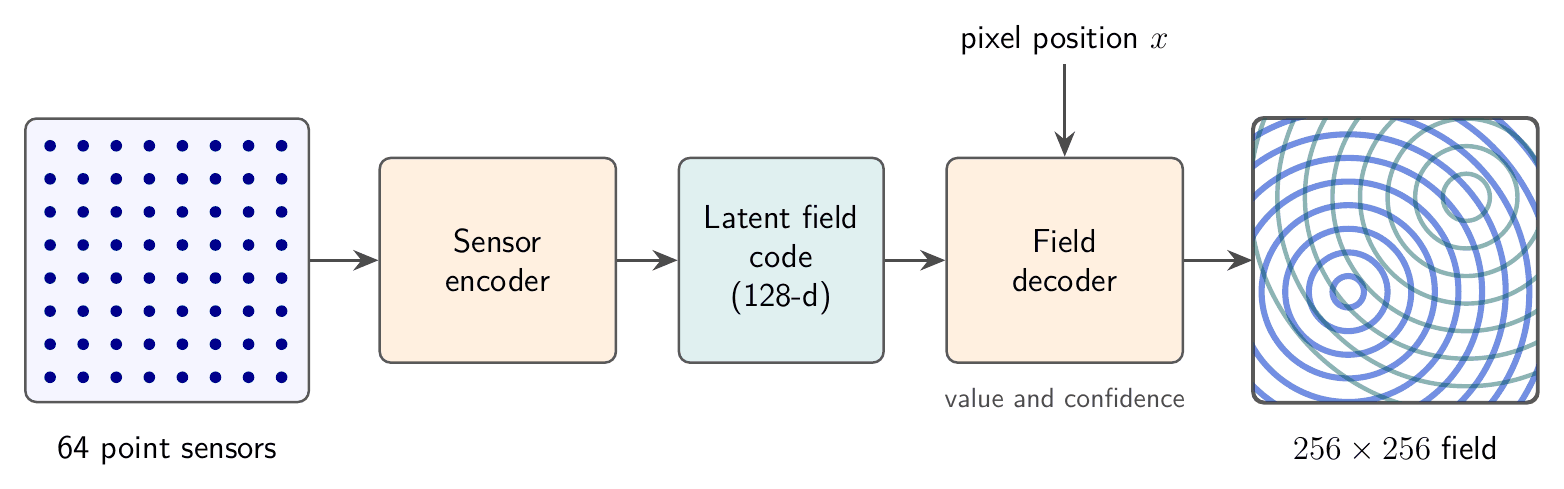
The input is 64 point sensors on a regular 8x8 grid. A sensor encoder maps the readings to a 128-dimensional latent field code. A coordinate-based field decoder then predicts the field value, and a confidence, at every pixel. Quillwave-Lite is the ablation without the latent code: its decoder is conditioned on the raw readings. Quillwave has 1.2M parameters and was trained on 2000 synthetic fields for 200 epochs.
Results
On RippleBench-Synthetic (500 synthetic test fields, 64 sensors, 256x256 fields, mean over 5 training runs), Quillwave improves PSNR by 5.41 dB over the best baseline, radial-basis interpolation. That is a 71.2% reduction in mean squared error, and Quillwave runs 1.36x faster than radial-basis interpolation. Linear interpolation is the fastest method. Quillwave has the highest PSNR at every sensor count tested (16, 32, 64 and 128); its margin over radial-basis interpolation is 4.14 dB at 16 sensors, 5.05 dB at 32, 5.41 dB at 64 and 5.23 dB at 128.
Table 1. Reconstruction quality on RippleBench-Synthetic (64 sensors, 256x256 fields, mean over 5 training runs). Higher PSNR and SSIM are better; lower runtime is better.
| Method | PSNR (dB) | SSIM | Runtime (ms) |
|---|---|---|---|
| Linear interpolation | 21.37 | 0.612 | 0.8 |
| Radial-basis interpolation | 24.05 | 0.701 | 6.4 |
| Quillwave-Lite (ablation) | 27.82 | 0.834 | 3.1 |
| Quillwave (ours) | 29.46 | 0.887 | 4.7 |
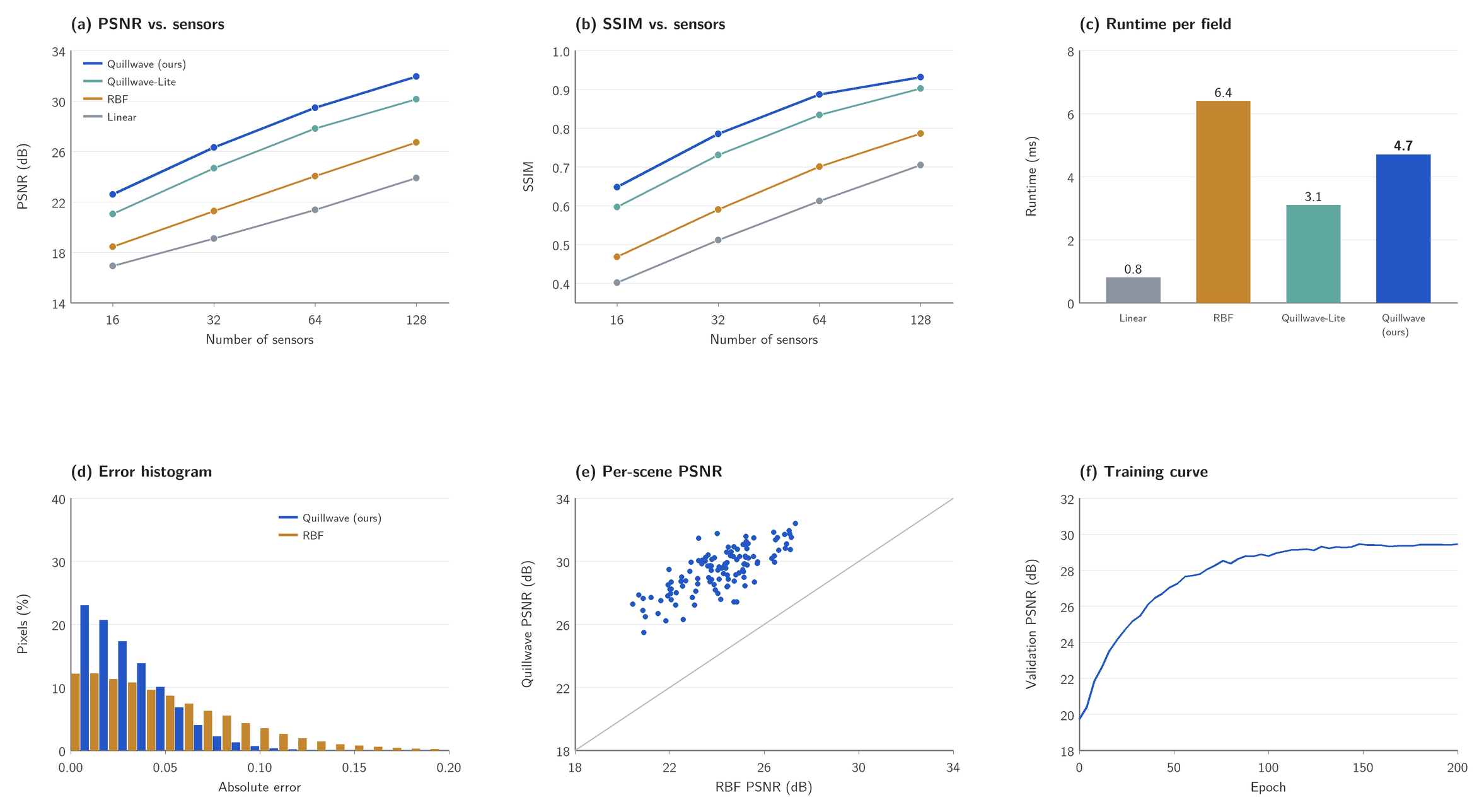
Qualitative Comparison
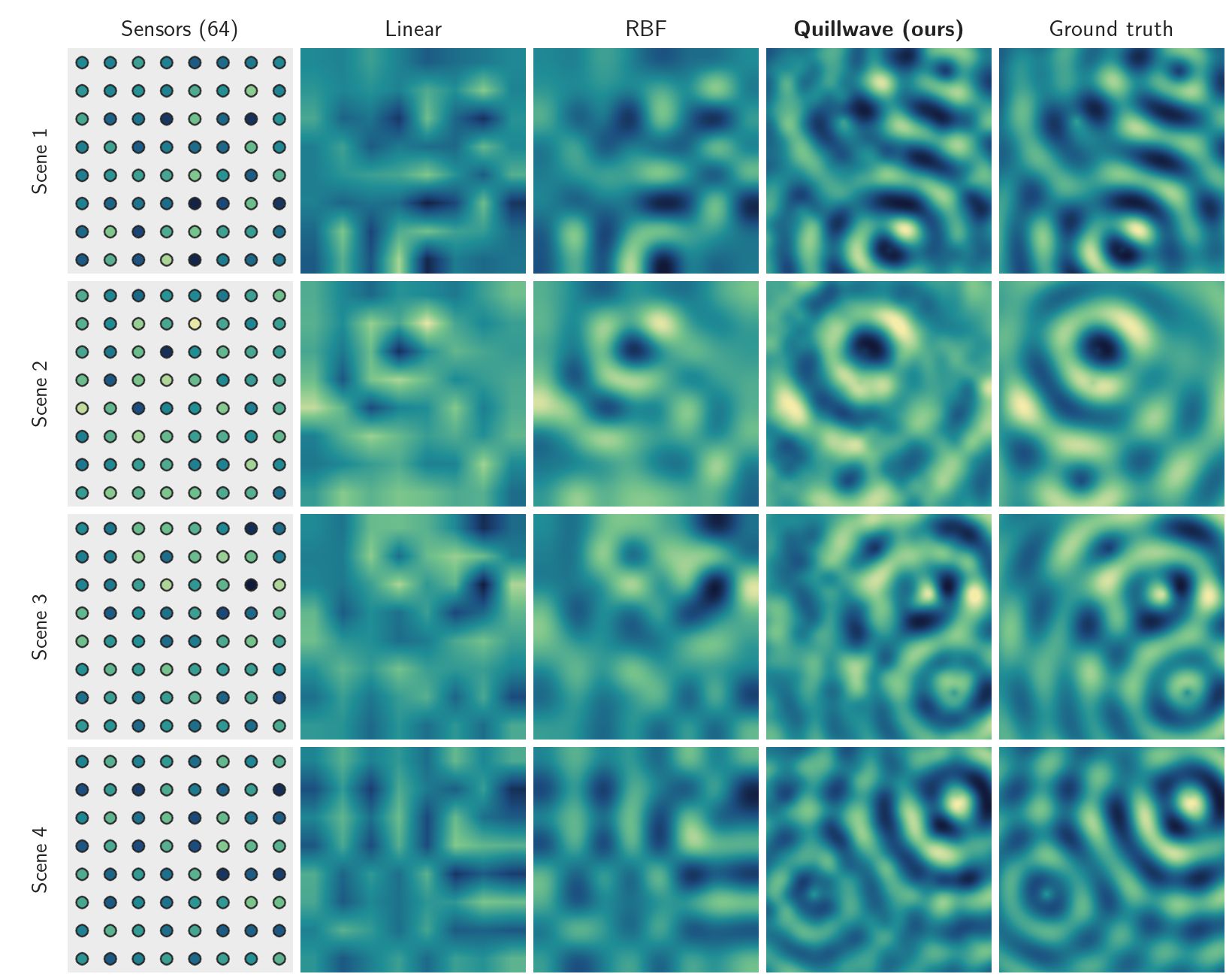
Comparison Loops
Limitations
- Baselines are not compute-matched. Quillwave is trained for 3.5 GPU-hours, while the interpolation baselines need no training at all.
- Synthetic fields only. Every result is on RippleBench-Synthetic; no real sensor data was used, and behaviour on real measurements is unknown.
- Confidence is not calibration. The per-pixel confidence map that Quillwave outputs has not been checked against observed error rates, so it should not be read as a calibrated probability.
BibTeX
@misc{placeholder2026quillwave,
  title  = {Quillwave: Sparse-Sensor Reconstruction of Synthetic Ripple Fields},
  author = {Ada Placeholder},
  year   = {2026},
  note   = {Research in preparation. Fictional entry for testing}
}